Italian Renaissance Cypress Cassone, Alto Adige, c.1550–1600
SKU: CASSCH
Couldn't load collection availability
UK Mainland Delivery & Non-Mainland
UK Mainland Delivery & Non-Mainland
* Until Christmas we are offering FREE UK MAINLAND doorstep delivery.
For UK Non-Mainland:
At checkout, please select ‘Pick up’ (not ‘Ship’) to complete your purchase.
You can either:
• Proceed with payment and we’ll send a separate link for delivery, or
• Contact us first for a quote, and we’ll send you a custom order link with delivery included.
Placing items in specific locations can be arranged on request — additional costs will apply. Our trusted fine art and antique couriers, ensuring your item arrives safely and with care.
International shipping
International shipping
International delivery, crating, shipping, and insurance can be arranged on request. We’ll provide a quote based on your needs—additional costs will apply and are payable directly to the shipping company.
You’re welcome to use your own shipping agent, or proceed with our recommended agent using the quote we supply. Payment is made directly to the shipping company.
Alternatively, select ‘Pick up’ at checkout to:
• Collect the item yourself
• Use your own shipping agent from our UK showroom
• Or simply complete your purchase
Contact us for a quote
An exceptional Italian Renaissance cassone, constructed in aromatic cypress wood and dating to the second half of the 16th century, c.1550-1600. Traditionally associated with the Alto Adige region of Northern Italy, this distinctive group of cypress chests also has strong associations with the wider Venetian world of Renaissance furniture and decorative arts.
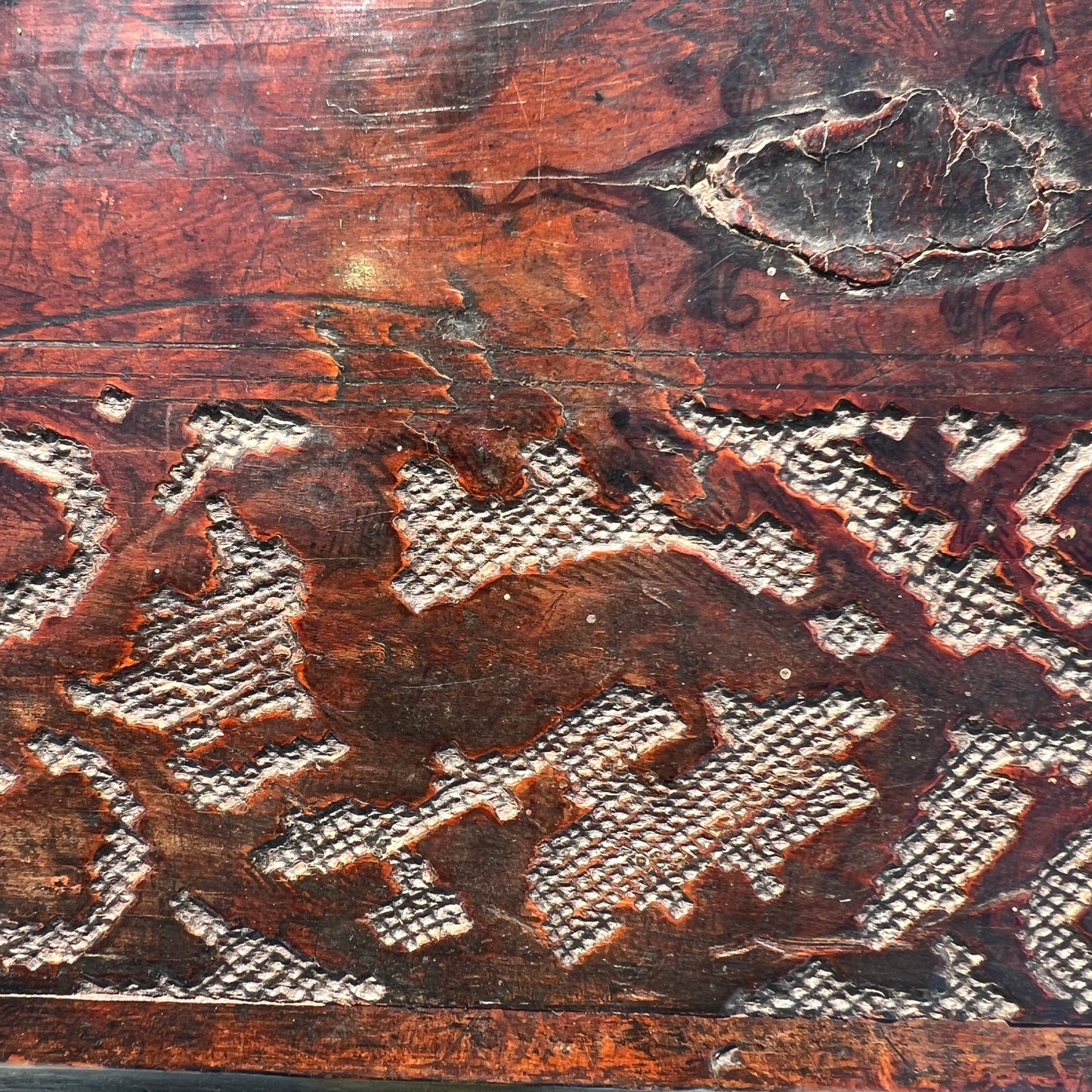
The cassone is extensively decorated using an unusual combination of shallow intaglio carving, punchwork and penwork. The designs were first drawn directly onto the timber in pen and ink, before areas of the surrounding ground were cut away to a depth of approximately 1–2mm and densely worked with repeated punches. The figures and ornament were left in smooth reserve, with their finer details articulated in penwork, creating an extraordinary effect akin to a Renaissance engraving translated into wood.
The decoration is particularly rich, comprising numerous framed narrative and allegorical scenes populated by triumphal chariots, horsemen, a lion, trumpeters, figures carrying weapons and trophies, winged putti and musicians. Amongst the surviving penwork are mermen and other marine figures, serpentine or dragon-like creatures, a figure playing a lyre, small dogs, hares, a snail and an unusual armadillo-like animal. Classical ornament includes an urn flanked by cornucopiae, while the interior retains a delicate linked floral garland executed in pen and ink.
These complex compositions reflect the influence of engraved prints circulating throughout Europe during the Renaissance, which provided craftsmen with a rich source of classical, Biblical, allegorical and fantastical imagery. Centuries of oxidation have naturally darkened the cypress and rendered some of the original penwork faint, but close inspection reveals a remarkable pictorial world surviving amongst the intaglio and finely punched grounds.
Intriguingly, the lid appears to have been reversed during the chest’s later history, bringing its richly decorated inner face to the exterior. The opposing face retains more restrained linked floral penwork, while the historic hinge arrangement provides further evidence of alteration. This reversal was probably undertaken during the 19th century, perhaps around the period in which the cassone was acquired for Broom Hall.
The chest retains substantial historic hand-forged ironwork and has developed a wonderful deep reddish-brown surface and patina over more than four centuries.
Provenance:
Broom Hall, Gwynedd, Wales, probably acquired for the house during the 19th century.
Related museum examples: Comparable Renaissance cypress cassoni are held in the Victoria and Albert Museum, London (Museum no. 4886-1858), and the Metropolitan Museum of Art, New York (Accession no. 30.95.132).
- Width: 167 cm (65.75″)
- Height: 66 cm (25.98″)
- Depth: 60 cm (23.62″)